

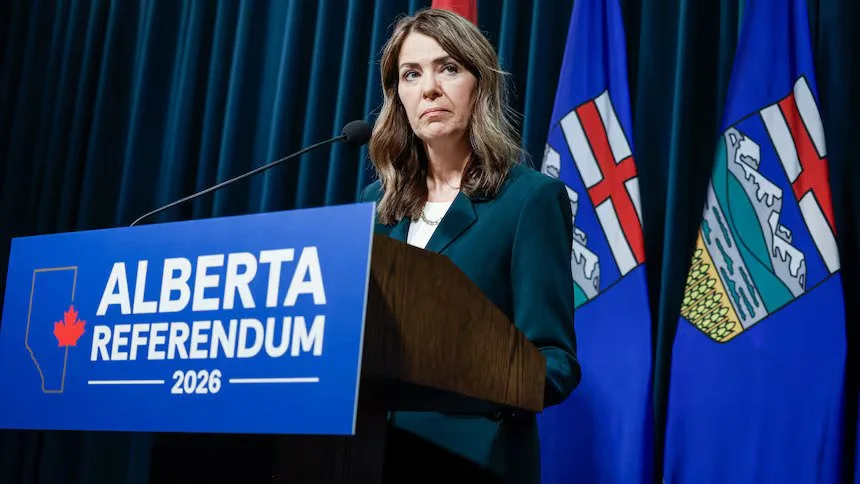
Source: The Canadian Press
Alberta’s referendum has given Premier Danielle Smith an opportunity to reset the political conversation, but not a blank cheque to pursue everything her government proposed.
The clearest message was that Alberta’s future remains within Canada. Beyond that, voters were selective: supportive of immigration-related changes and new voting-documentation requirements, but unwilling to endorse the government’s constitutional reform package.
For the UCP, the challenge is turning those results into a coherent governing agenda. For the NDP, it is preventing Smith from leaving the referendum’s political baggage behind. The coming legislative session will provide the first test of both strategies.
The Results: Staying in Canada, Without Endorsing Everything
Approximately three-quarters of voters chose to remain in Canada, while roughly one-quarter supported beginning the legal process toward a future binding referendum on independence. These remain unofficial results, with Elections Alberta scheduled to publish official results on October 29.
During Alberta Counsel’s After the Vote: Unpacking Alberta’s Referendum webinar, senior advisor and former UCP MLA Michaela Frey emphasized that “this question was about a vote to have a vote.” She argued that some Option 2 voters wanted to send Ottawa a message rather than necessarily leave Canada. The remaining questions produced a more divided verdict.
The five proposals concerning immigration, access to provincial services and proof of citizenship for voting received majority support. Support for increased provincial control over immigration approached 55 per cent, while the three service-access proposals attracted narrower majorities of approximately 52 to 53 per cent.
All four constitutional-amendment proposals were rejected. Those concerned judicial selection, Senate abolition, opting out of federal programs while retaining funding, and giving provincial laws priority in specified areas of jurisdiction.
The result is therefore neither an unconditional endorsement of Smith’s agenda nor a complete rejection of it. There is room to pursue practical changes within Confederation, but little basis for claiming voters delivered a mandate for another constitutional confrontation.
The UCP: Drawing a Firmer Line
Smith’s October 20 address contained an unmistakable commitment:
“For as long as I am Premier, I will honour this mandate from Albertans and will not be holding another referendum on this issue.”
She also said future disputes with Ottawa would be pursued “within the political and legal institutions of our nation rather than pursuing the option of separation.”
For conservatives who want provincial autonomy without the economic and political uncertainty of separation, that is a welcome distinction. Defending Alberta’s interests does not require keeping its departure from Canada permanently on the table.
Smith is attempting to apply that distinction inside her party.
In her subsequent media availability, she said candidates and people speaking officially for the UCP must accept the result. However, when pressed about disqualifying individuals who refuse, she stopped short of announcing a formal enforcement mechanism.
Her later CBC interview reinforced the expectation without resolving every procedural question. “It is settled in my party,” she insisted, while again telling prospective candidates and board members to align with the electorate’s decision.
The distinction is between holding a personal opinion and representing the party. It is not yet evidence of a sweeping removal of separatist members.
As Frey observed during the webinar, “the biggest test of this will be at the UCP AGM,” where members will elect board representatives and debate policy.
Smith now has a strong democratic argument for closing this debate. Whether that argument produces discipline inside the UCP remains an open question.
The NDP: Keeping the Government on the Defensive
The NDP has little incentive to let the referendum disappear from political discussion simply because Smith wants to move forward.
Former NDP minister and Alberta Counsel senior advisor Richard Feehan described the party’s likely calculation plainly during the webinar: “the more internal chaos there is in the UCP, the better it is for the NDP.” He expects the Opposition to keep pressing Smith over separatist influence and the consistency between her statements and her actions.
Nenshi is also challenging the government’s interpretation of the immigration results. He has accused Smith of scapegoating newcomers and argued that restricting their access to services will not address underlying problems in health care and education.
“It’s not going to make your classrooms any smaller,” he told CBC’s Power & Politics.
That is an argument about policy effectiveness, rather than simply whether the proposals passed.
The NDP nevertheless faces its own complication. Majorities did support the five immigration and voting-related proposals. The Opposition cannot reasonably treat the entire referendum as an endorsement of its position.
Its stronger argument is that narrow victories require careful implementation, and that the government must demonstrate how any changes would improve services rather than merely identify someone else to blame.
For Smith, the answer will need to be tangible results. For Nenshi, the challenge is offering an alternative beyond continuing to litigate the referendum politically.
Carney: An Opening for Negotiation
Ottawa’s response suggests immigration could become another area of practical Alberta-federal cooperation. Asked about a Quebec-style immigration agreement for Alberta, Carney replied, “We’ll see,” while emphasizing that “Quebec is distinct.”
Even before the vote, he had indicated an interest in greater cooperation with provincial governments on immigration.
Smith, meanwhile, says Alberta is preparing a proposal inspired by the Canada-Quebec accord, with particular attention to selecting economic migrants whose skills match provincial needs. She has emphasized the workers required for construction and industrial development.
That creates an opportunity to move from broad referendum language to specific negotiations.
It also exposes a necessary balancing act. A government seeking more sustainable population growth must still explain how it will meet employers’ workforce needs. Greater provincial influence would bring greater responsibility for those choices.
An opening for discussions is not a completed agreement, and the referendum does not automatically determine its contents. Nor should negotiations over immigration selection be confused with approval of every proposed restriction on provincial services.
The conservative case for this approach is straightforward: greater provincial influence should produce better decisions for Alberta. Separation is not required to pursue it.
What Comes Next: A Session Focused on Delivery
The government’s fall preview signals an effort to shift attention toward affordability, public services and consumer protection.
At his October 23 news conference, Government House Leader Joseph Schow was explicit: “We will not have immigration legislation brought forward this sitting.” He instead pointed toward further work with Ottawa and developments around economic migration as early as next spring.
Smith has separately identified proof-of-citizenship requirements for voting as likely to be the first referendum-related measure addressed through enabling legislation. Her interview did not establish a definite fall introduction date.
The announced fall agenda includes further auto-insurance changes, utility-bill protections, coordination of mental-health services and amendments preparing the Compassionate Intervention program for its planned 2027 launch. Education proposals include stronger oversight and consistent report-card standards.
Other measures concern data-centre safeguards, childcare incident notifications, defective vehicles, ticket resale and digitally altered intimate content. Provincial authority over bike lanes and merit-based public-sector hiring also feature, suggesting the sitting will not be entirely free of contentious debates.
Politically, however, the intended shift is clear: from debating Alberta’s place in Canada to demonstrating how government can improve life within it.
Frey captured that opportunity during the webinar, saying the referendum’s conclusion allows government to “get on to the business of governing.” She also advised organizations that their government-relations plans need to remain flexible as priorities develop.
For businesses, municipalities, and non-profits, the practical implication is to connect proposals to the priorities ministers are now emphasizing: affordability, reliable services, investment, and measurable improvements.
For the UCP, the task is more demanding. Accepting the referendum result is the necessary first step. Showing that the government can act on its lessons is the next.
Albertans have rejected another separation vote. The coming session will test whether their government can make the conversation about what it delivers instead.