

Ottawa and Alberta Are Pulling in the Same Direction. Not Everyone Is Buying It
Source: The Canadian Press
For years, the defining feature of Alberta’s relationship with Ottawa was conflict. Pipelines were delayed or cancelled, federal environmental regulations became permanent sources of litigation and political leaders in Edmonton built entire campaigns around the argument that Ottawa does not respect Alberta’s economic interests.
That is no longer an accurate description of the relationship. The shift has been developing for more than a year. But the October 1 announcement that Ottawa has designated the Pacific Link pipeline as Canada’s first project of national interest under the Building Canada Act makes it increasingly difficult to dismiss the change as rhetorical.
Alberta and Ottawa are now working together toward a shared objective that would have appeared improbable during the Trudeau era: expand oil sands production, move another million barrels of crude per day to the Pacific coast, and sell more Canadian energy to Asian markets.
Premier Danielle Smith is making sure Albertans understand the significance.
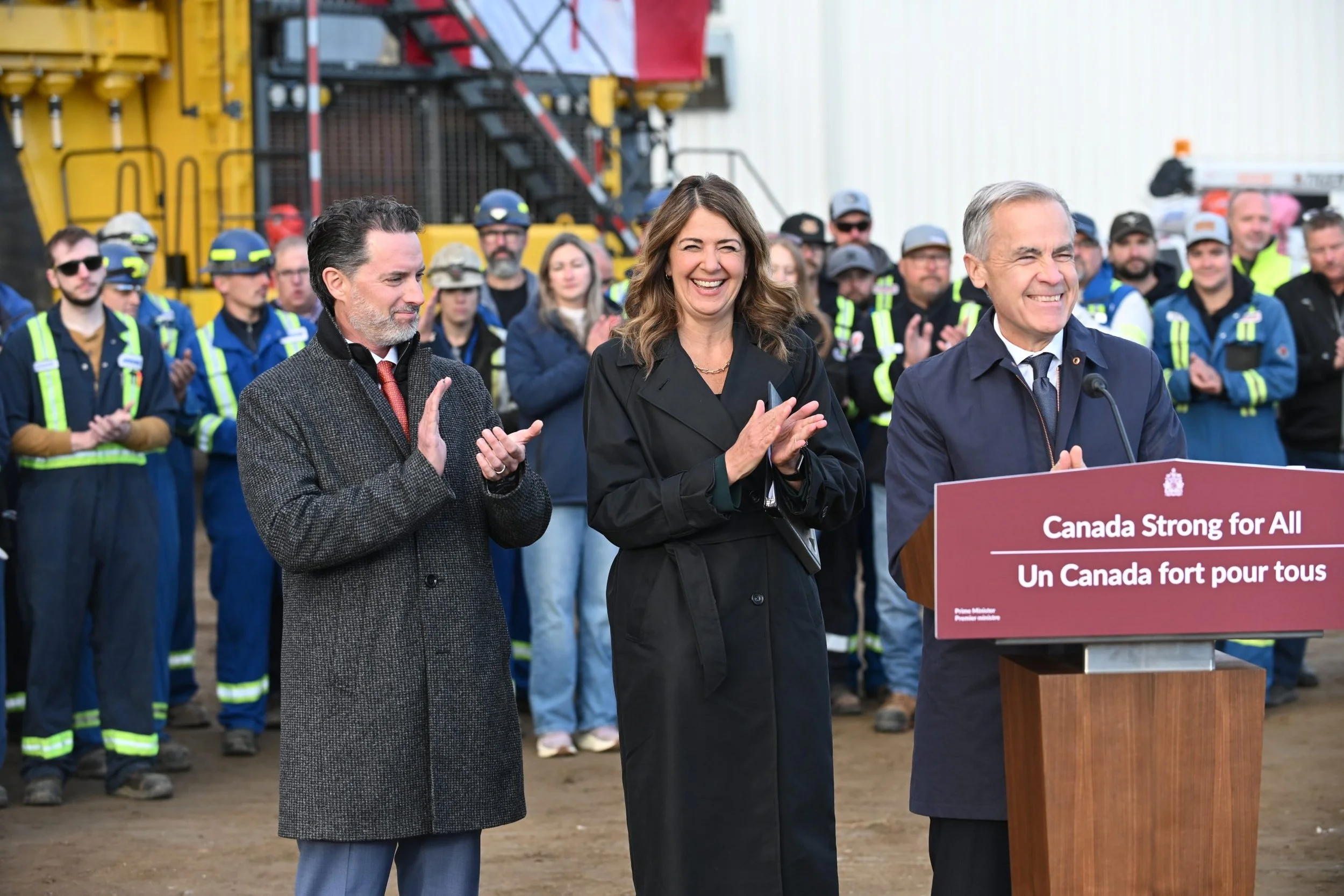
“This is a monumental day for our province and for our country,” she said in Fort McMurray, describing Pacific Link as the product of sustained cooperation between Alberta, Ottawa, Indigenous partners and industry.
The question now is whether Smith can persuade parts of her own political UCP coalition to see the same progress she does.
From Fighting Ottawa to Building With It
Pacific Link is still a proposed pipeline, not pipe in the ground.
The roughly 1,200-kilometre project would follow a southern route through British Columbia, largely alongside the existing Trans Mountain corridor, before reaching a new terminal at Roberts Bank. It is intended to move more than one million additional barrels per day to tidewater. Alberta currently lists the project at an estimated $43.7 billion, with completion targeted around 2032.
The national-interest designation matters because it puts the federal government behind the project at the beginning of the regulatory process rather than leaving proponents to spend years seeking an uncertain decision.
Ottawa’s Major Projects Office is expected to spend the coming year establishing conditions for the project, with construction potentially beginning as early as September 1, 2027 if consultations, approvals and permits are completed.
That is not a final investment decision. There are real questions about cost, Indigenous consultation, environmental conditions and the extent of private-sector participation.
But it is also considerably more than the symbolic pipeline announcement critics predicted Ottawa would never make. More importantly, Pacific Link sits within a much broader realignment.
Smith noted in Fort McMurray that the Alberta-Ottawa energy agreement has already included Ottawa’s commitment not to proceed with the federal oil and gas emissions cap, changes involving clean-electricity rules, an impact-assessment agreement intended to reduce duplication, suspension of the federal zero-emission vehicle mandate and removal of controversial Competition Act provisions governing environmental claims.
The language coming from Prime Minister Mark Carney is equally striking.
Carney described Alberta’s oil sands as part of Canada’s opportunity to become a “global energy superpower” and framed Pacific Link as infrastructure needed to diversify Canadian trade away from the United States. Ottawa estimates the pipeline could eventually contribute more than $20 billion annually to GDP and generate more than $100 billion in government revenue by 2060.
Those are not the words Alberta Conservatives grew accustomed to hearing from Liberal governments.
Smith Is Claiming the Win
Smith’s political argument is becoming clear.
For years, she told Albertans that confrontation with Ottawa was necessary because federal policies were harming the province. She now wants to demonstrate that confrontation was a means rather than the objective.
On CTV’s Power Play, Smith said the relationship today is “a very different conversation” from 18 months ago and argued that recent decisions will gradually convince skeptical Albertans that Canada can work better for the province. She said the “vast majority” of her caucus believes Alberta is making meaningful progress with Ottawa.
That is an important evolution. Smith is not suddenly arguing that Alberta’s grievances were exaggerated. Her pitch is almost the opposite: the grievances were real, the pressure worked, and Alberta is now receiving concessions that previously seemed unavailable.
Pacific Link is evidence for Smith’s case that aggressive provincial advocacy can produce results without leaving Confederation. The same pattern is appearing outside energy.
Only days before the pipeline announcement, Alberta and Ottawa jointly announced their intention to advance a high-speed rail link between Calgary, Red Deer, and Edmonton. Alberta plans to solicit private-sector proposals this fall, while Ottawa has committed to refer the project to the federal Major Projects Office and work with the province on planning and financing once Alberta selects a proponent.
A pipeline and passenger rail are obviously different projects. Politically, however, they reinforce the same point. Ottawa and Edmonton are increasingly behaving like governments with shared objectives rather than permanent adversaries.
An Awkward Moment for Poilievre
That creates an unusual problem for federal Conservative Leader Pierre Poilievre.
Poilievre’s central argument remains that Carney talks about growth while failing to deliver it. Speaking to Rick Bell before the Pacific Link announcement, he dismissed the prime minister as “an illusion” and responded to discussion of the pipeline with a pointed question: “What pipeline?”
His standard remains physical construction.
“Wake me up when there’s pipe in the ground,” he said.
Conservatives have years of experience watching major infrastructure proposals die during regulatory processes, and Pacific Link still has major hurdles ahead. But the political contrast is interesting.
Poilievre wants Albertans to remain skeptical of Carney’s conversion on energy. Smith increasingly wants them to believe that conversion is real enough to work with. The two Conservatives are not necessarily divided on what should ultimately be built. They are divided in emphasis.
Poilievre benefits politically from arguing that Carney has accomplished very little. Smith benefits from arguing that her negotiations with Carney have accomplished quite a lot. Pacific Link makes that tension harder to hide.
Nenshi Finds His Own Opening
Naheed Nenshi is approaching the announcement differently.
Unlike federal NDP Leader Avi Lewis, Nenshi supports Pacific Link and has emphasized his preference for its southern route. That has given the Alberta NDP leader an opportunity to distance himself further from the federal NDP on energy.
“Folks can say what they want in Ottawa; here in Alberta, we get stuff built,” Nenshi said after Lewis criticized the project.
Nenshi is simultaneously questioning why governments must assume so much of the financial exposure if the project has the commercial potential its supporters describe. He has also argued that regulatory uncertainty remains one reason private capital is cautious.
Politically, his focus is aimed at Smith’s right flank.
When Smith challenged him over the federal NDP’s opposition to the pipeline, Nenshi responded by telling her to “kick out the separatists.” It is an obvious attempt to move attention from the pipeline itself, where the two provincial leaders are closer than either may prefer to admit, to the internal disagreement Smith continues to manage over the referendum.
The Right Is Not Fully Convinced
Red Deer-South UCP MLA Jason Stephan has already voted for Option 2 in the October 19 referendum, which would begin the process toward a future binding vote on Alberta independence.
His newsletter to constituents makes his rationale explicit.
Stephan argues that Option 1 “entrenches the status quo,” while Option 2 “puts Ottawa on notice.” He maintains that supporting another referendum does not necessarily mean supporting independence itself. A voter, he writes, can want Alberta to remain in Canada while still wanting the threat of a future referendum to force federal change.
At a Red Deer town hall, Stephan told CBC that he would “love nothing more than for Canada to fix itself,” but said he does not yet believe that has happened.
That is precisely the constituency Smith is trying to persuade with Pacific Link.
Some commentators on the populist right are similarly reluctant to declare victory. The reaction is essentially: acknowledge the announcement, but do not confuse a federal designation with steel in the ground.
After a decade of broken trust, that skepticism should not be surprising. But it creates a political dilemma for Smith.
The AGM After the Referendum
Smith is now staking considerable political capital on the argument that Alberta’s strategy has worked. She can point to federal movement on energy regulations, the Pathways partnership, Pacific Link, high-speed rail cooperation, and a prime minister publicly describing Canadian oil as central to national prosperity.
For much of the electorate, that may be persuasive evidence that relations have materially improved. For the most distrustful portion of the UCP coalition, it may not be enough.
That matters beyond October 19.
UCP members will gather in Calgary for the party’s AGM from November 27 to 29, where policy resolutions and internal governance will again put grassroots priorities directly in front of the premier.
If a significant part of the membership leaves the referendum believing Ottawa remains fundamentally untrustworthy, Smith could find herself celebrating the largest Alberta-Ottawa energy agreement in years while simultaneously managing members demanding more confrontation.
That may be the real political test created by Pacific Link. For the first time in years, the Alberta premier is not arguing that Ottawa refuses to listen. She is arguing that Ottawa finally is.
Whether Smith’s base believes her may prove almost as important as whether the pipeline gets built.