


Source: The Canadian Press
After Alberta’s referendum, in which all four immigration-related questions passed, Prime Minister Mark Carney said he would not rule out an immigration agreement for Alberta similar to Quebec's agreement with the federal government. Such an agreement could give Alberta more responsibility for selecting immigrants and delivering settlement services, though the extent of those changes would depend on what the two governments negotiate.
Alberta already has some control over economic immigration through its provincial nominee program. Quebec’s agreement goes further, giving the province broader authority over economic immigrant selection and responsibility for settlement services with federal funding. For Alberta, the implications would extend to employers seeking workers, municipalities planning for growth, and the organizations supporting newcomers. However, an agreement would also have limits, particularly given the changes supported in the referendum.
Where Alberta stands today
Alberta’s main selection tool is the Alberta Advantage Immigration Program (AAIP). Through it, the province nominates workers and entrepreneurs for permanent residence based on provincial economic priorities. Its streams include pathways for people working in Alberta, candidates in the federal Express Entry system, rural communities, and business owners.
The process involves both governments. Alberta assesses candidates and issues nominations. Nominees then apply to Immigration, Refugees and Citizenship Canada, which makes the final permanent-residence decision. A nomination does not itself give someone permanent resident status.
Alberta’s discretion also operates within a federal allocation. As of early November, Alberta’s published 2026 allocation is 6,603 nominations, with additional opportunities for qualifying physicians and Francophones outside that allocation. Alberta can prioritize particular occupations and communities, but it cannot unilaterally expand its nomination spaces.
This allocation covers provincial nominations, rather than the total number of people moving to Alberta. People also arrive through federal economic programs, family sponsorship, refugee pathways, and interprovincial migration, all of which fall outside Alberta’s nomination allocation.
The broader Canada–Alberta agreement provides for consultation and cooperation on immigration planning, temporary residents, and settlement. It gives Alberta a voice, but does not give the province comprehensive control over who settles here.
What Quebec does differently
The Canada–Quebec Accord, which took effect in 1991, gives Quebec broader responsibility for selecting economic immigrants destined for the province. Quebec establishes its own criteria and programs, allowing it to emphasize priorities such as French-language ability and labour-market needs.
Applicants who meet those criteria and are selected by the province receive a Quebec Selection Certificate, which they then use to apply to the federal government for permanent residence. Ottawa remains responsible for the final decision, including the required medical, criminal, and security checks. While Quebec can determine which economic immigrants meet its provincial priorities, those applicants must still meet federal requirements before they can become permanent residents.
Quebec establishes its desired immigration levels, which Ottawa considers when setting national levels. Federal responsibilities include family-class selection, refugee claims made within Canada, and certain temporary-resident streams, although Quebec assesses family sponsorship undertakings. Quebec’s consent is required for temporary foreign workers subject to labour-market assessment requirements.
Another major difference is settlement. Under the Accord, Ottawa withdrew from specified reception and integration services and compensates Quebec for delivering them. That funding comes with conditions: the services must be broadly comparable to those offered federally elsewhere and available to permanent residents in Quebec without discrimination, regardless of whether the province selected them.
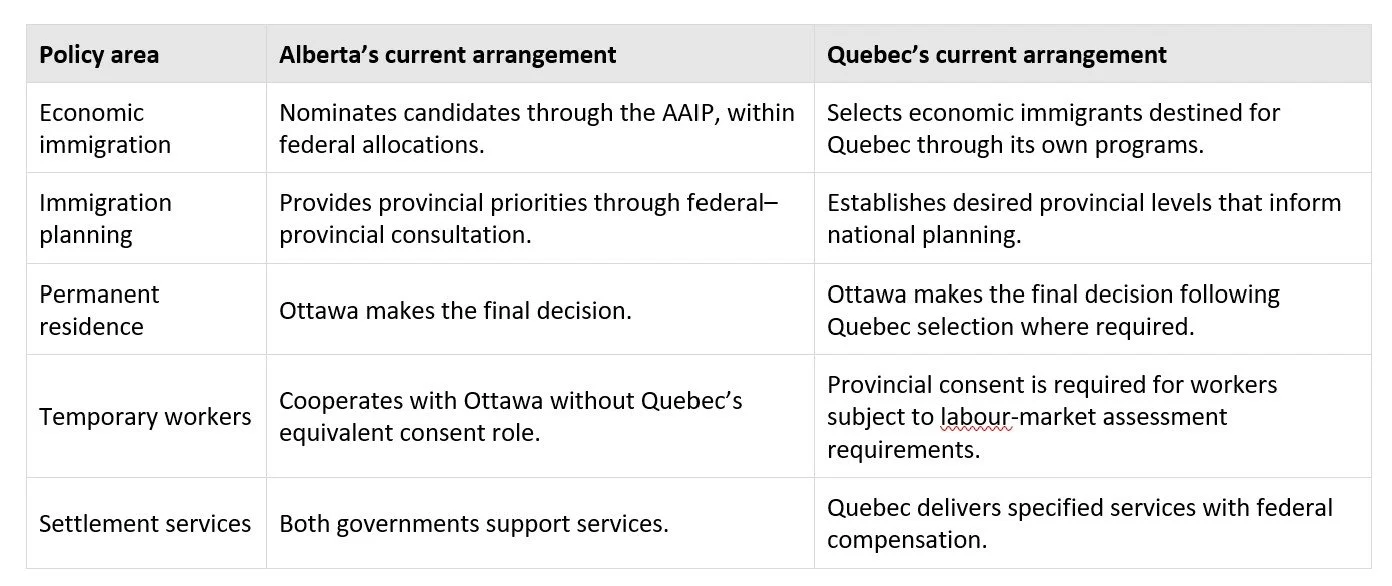
The chart below summarizes the key differences between Alberta’s and Quebec’s current immigration arrangements.
What an Alberta agreement could look like
An Alberta agreement could draw on Quebec’s approach, but Alberta and the federal government would need to negotiate responsibilities and funding. This would include determining which immigrants Alberta would select, how much input the province would have into immigration levels, and whether it would assume responsibility for federally funded settlement services.
The most significant change could be Alberta’s role in economic immigration. Through the AAIP, the province already nominates workers and entrepreneurs based on provincial priorities. A Quebec-style agreement could give Alberta responsibility for selecting a broader share of economic immigrants coming to the province, with criteria developed around its labour-market needs. Employers, municipalities, and regional organizations could help inform those criteria, particularly where rural and smaller communities have different needs from Edmonton and Calgary.
However, greater authority over selection would not automatically resolve the challenges employers and communities face. A health professional selected by Alberta would still need to meet provincial licensing requirements before practising. Housing availability, access to services, and employment opportunities for family members would also remain important to attracting and retaining workers.
Alberta could also negotiate greater input into immigration levels and a role in approving certain temporary-worker admissions. This could allow the province to better account for pressures on housing, infrastructure, and public services when discussing immigration targets with Ottawa. The extent of that influence would depend on the agreement, including which immigration categories it covered and which decisions remained federal.
For nonprofit organizations, a change in responsibility for settlement services could have more immediate implications. Under a model similar to Quebec’s, Alberta could receive federal funding to administer services such as language training, employment assistance, and support for newcomers navigating community services. Organizations delivering those programs would need clarity on funding agreements, eligibility requirements, reporting obligations, and whether existing services would continue during the transition.
The amount and structure of that funding would be an important part of negotiations. Alberta would be taking on responsibility for services that need to respond to changing demand, including in smaller communities where access may already be limited. Any agreement would need to account for the cost of delivering those services and the capacity of the organizations providing them.
Alberta could also seek changes to its existing agreement, including increasing the number of nominations available through the AAIP. This would allow the province to nominate more workers and entrepreneurs without taking on the additional responsibilities associated with Quebec’s model. Depending on what Alberta seeks to achieve, some changes could be negotiated within the current program, while others would require a broader agreement with Ottawa.
How the referendum fits
According to Elections Alberta’s official results, all four directly immigration-related questions passed with narrow majorities. Support ranged from 54.86 percent for greater provincial immigration control to 51.78 percent for healthcare and education fees or premiums for people with non-permanent immigration status. Voters also supported restrictions on eligibility for provincial programs and a 12-month residency requirement for certain social supports.
The first question has the clearest connection to a Quebec-style agreement. It combined greater provincial control with lower immigration levels, a focus on economic migration, and employment priority for Albertans. A larger role in selecting economic immigrants could help Alberta meet workforce needs, but it would not necessarily achieve all those objectives.
Reducing immigration could ease some demand pressures, but it could also make recruitment harder in sectors already experiencing shortages. Alberta would need to consider that trade-off, including the workers needed to build housing and deliver public services. Citizens and permanent residents also have constitutionally protected rights to move between provinces, meaning Alberta could not simply prevent people admitted elsewhere in Canada from subsequently moving here.
The other immigration-related questions focused on eligibility for provincially funded programs, a residency requirement for certain social supports, and fees for health care and education. Implementing these proposals would require separate provincial decisions and, where necessary, legislation consistent with applicable law. While the results support the government in pursuing these changes, the questions were non-binding. Neither the referendum results nor a Quebec-style immigration agreement would, on their own, put those measures in place.
For employers, municipalities, and nonprofit organizations, these discussions offer an opportunity to identify where the current system creates difficulties and what changes would help. That could include unfilled positions, gaps in settlement services, or funding that does not reflect local demand. Bringing those concerns forward would help connect negotiations about provincial responsibilities to the needs of the communities and organizations affected.
A Quebec-style agreement could give Alberta greater influence over immigration, but it would also add costs and responsibilities for selecting and supporting newcomers. Whether that improves the current system would depend on the terms negotiated with Ottawa, available funding, and Alberta’s capacity to administer the changes. The referendum results support pursuing a greater provincial role, but an agreement would address only some of the objectives voters endorsed. As discussions proceed, input from employers, municipalities, nonprofit organizations, and newcomers would help identify where changes are needed and what would be required to make them work in practice.
