

Canada’s Energy Leverage Problem
Source: Toronto Star
U.S. President Donald Trump’s decision to impose an additional 50 per cent tariff on a broad range of Canadian goods beginning August 19 has reopened one of the most politically dangerous questions in Canadian federalism: should Canada retaliate by restricting the export of oil, potash, electricity, or other strategic commodities to the United States?
Ontario Premier Doug Ford believes those options should remain on the table.
“No matter if it’s the electricity, and I’m not speaking for the other provinces, I’m going to be very clear, the potash, the oil … they need to feel the pain,” Ford told reporters during meetings with Canada’s premiers in Charlottetown.
Alberta Premier Danielle Smith’s response was immediate.
“That’s not going to happen,” she said.
That disagreement reflects two competing views of how Canada should respond to a more protectionist and antagonistic United States.
One approach treats Canadian energy and natural resources as weapons to be deployed in a trade war. The other sees those exports as the country’s strongest source of economic resilience and argues that weakening them would do more damage to Canada than to the United States.
From Alberta’s perspective, the second argument is considerably stronger.
A New Tariff Front
The latest U.S. action applies a 50 per cent tariff to a lengthy list of Canadian products, including alcohol, dairy products, agricultural goods, paper, furniture, electronics, clothing, textiles, sporting equipment, and industrial materials.
They cover products ranging from beer, wine, whisky, and hockey equipment to dairy ingredients, paper products, furniture, electronics, and clothing. The tariff order explicitly states that a 50 per cent ad valorem tariff will apply to the listed articles unless they are already subject to separate U.S. trade restrictions.
Alcohol is among the most politically visible targets. The tariff schedules include beer, wine, cider, whisky, vodka, rum, tequila, and other spirits.
Other lists target concentrated milk, whey, milk proteins, lactose products, and other dairy inputs, reflecting the Trump administration’s continued frustration with Canada’s supply management system.
The new tariffs are also significant because they apply to goods covered under the Canada-United States-Mexico Agreement. That undermines one of the central assumptions of the agreement: that qualifying goods moving within North America would enjoy predictable, preferential access.
For businesses, certainty is almost as important as the tariff rate itself. Companies can adapt to known rules. They struggle to invest when those rules can be rewritten by executive action with little warning.
The Canada-U.S. relationship has been built over decades around integrated supply chains, shared infrastructure, and a basic expectation that trade agreements would provide stability. The latest escalation calls that expectation into question.
Initial estimates suggest Ontario, Quebec, and British Columbia will be hit much harder than Alberta and Saskatchewan. University of Calgary economist Trevor Tombe estimated that 13.7 per cent of British Columbia exports, 10.8 per cent of Quebec exports, and nine per cent of Ontario exports could be affected. By comparison, roughly one per cent of Alberta exports and 1.2 per cent of Saskatchewan exports would be exposed.
That difference helps explain why Ford is demanding a more forceful response.
Ontario’s auto sector and manufacturing base are more vulnerable to tariff escalation. Alberta’s largest export, energy, is expected to remain exempt, along with critical minerals and potash.
But Alberta is not insulated from the broader consequences.
The United States remains Alberta’s largest trading partner. In 2025, Alberta exported more than $152 billion in goods to the U.S., with energy products accounting for approximately $125.2 billion. Plastics, machinery, meat, forestry products, and organic chemicals also represent billions of dollars in cross-border trade.
Any lasting disruption to the Canada-U.S. relationship would affect investment decisions, commodity prices, supply chains, and business confidence across the province.
The question is whether Canada should respond by damaging the one trading relationship that remains most economically valuable.
Ford’s argument has political appeal. Canada supplies the United States with roughly 4.3 million barrels of oil per day, almost all of it produced in Alberta and Saskatchewan. Saskatchewan also supplies approximately 85 per cent of the potash used by American farmers. Crude oil is Canada’s largest export to the U.S., while potash is its most important mineral export.
Those numbers make oil and potash look like obvious bargaining chips.
If the United States is willing to target Canadian manufacturing, agriculture, alcohol, and consumer goods, why should Canada continue supplying strategic resources without disruption?
The problem is that leverage only works when using it hurts the other side more than it hurts you.
Restricting oil exports would reduce revenue for Canadian producers, workers, governments, and communities. It could also undermine Canada’s reputation as a reliable supplier at precisely the moment the country is trying to attract capital and expand exports.
The same is true of potash. American farmers would face higher costs, but Saskatchewan producers would lose access to their largest market. Competitors would gain an opportunity to fill the gap. Once customers establish alternative supply relationships, they may not return.
Former Saskatchewan natural resources minister Tim McMillan summarized the problem well.
“What Ford gets right is that potash is a phenomenal resource … what he gets wrong is that it should be sacrificed to defend industries where, arguably, he and the federal government haven’t put into a position of strength,” he said.
“By killing the golden goose, you aren’t saving the country. You’re just making the country worse.”
That is the core conservative objection to using energy as retaliation. It converts a competitive advantage into self-inflicted economic damage.
Smith’s Case for Restraint
Smith has consistently argued that diplomacy, not escalation, offers the best path forward.
When asked whether oil and potash could be used as retaliatory measures, she rejected the idea and said the coming weeks should be focused on reaching a negotiated resolution.
Her position is that Canada should work toward preserving a tariff-free relationship under CUSMA rather than threatening industries that support hundreds of thousands of Canadian jobs.
Alberta has taken the same approach to American liquor. While several provinces removed U.S. alcohol from government-controlled shelves during earlier tariff disputes, Alberta kept American products available, arguing that a boycott would hurt workers and businesses on both sides of the border.
That approach has attracted criticism from those who believe Canada must demonstrate greater willingness to retaliate. But it is consistent with the province’s broader position: trade barriers are economically destructive regardless of which government imposes them.
Tariffs raise costs, reduce consumer choice, discourage investment, and invite retaliation. Responding to bad policy with additional bad policy may be politically satisfying, but it rarely produces a better economic result.
Smith’s position also reflects Alberta’s experience within Confederation. Western resources have frequently been treated as national assets when other regions need them and provincial assets when Alberta seeks greater control over their development.
It is therefore unsurprising that Alberta reacts strongly when political leaders in Central Canada suggest using western oil as a bargaining chip to protect industries concentrated elsewhere.
The issue is not a lack of national solidarity. It is whether one region should be expected to absorb disproportionate losses because another region is facing a more direct tariff threat.
Energy Is More Valuable as an Asset Than a Threat
The better way to use Canadian energy as leverage is not to stop exporting it. It is to create more options for where it can go.
Canada’s dependence on the U.S. market is the result of infrastructure, not geology. Alberta has world-scale oil and natural gas reserves, but for decades its producers have had limited access to tidewater and eastern Canadian markets.
That is why recent pipeline proposals have taken on renewed political importance.
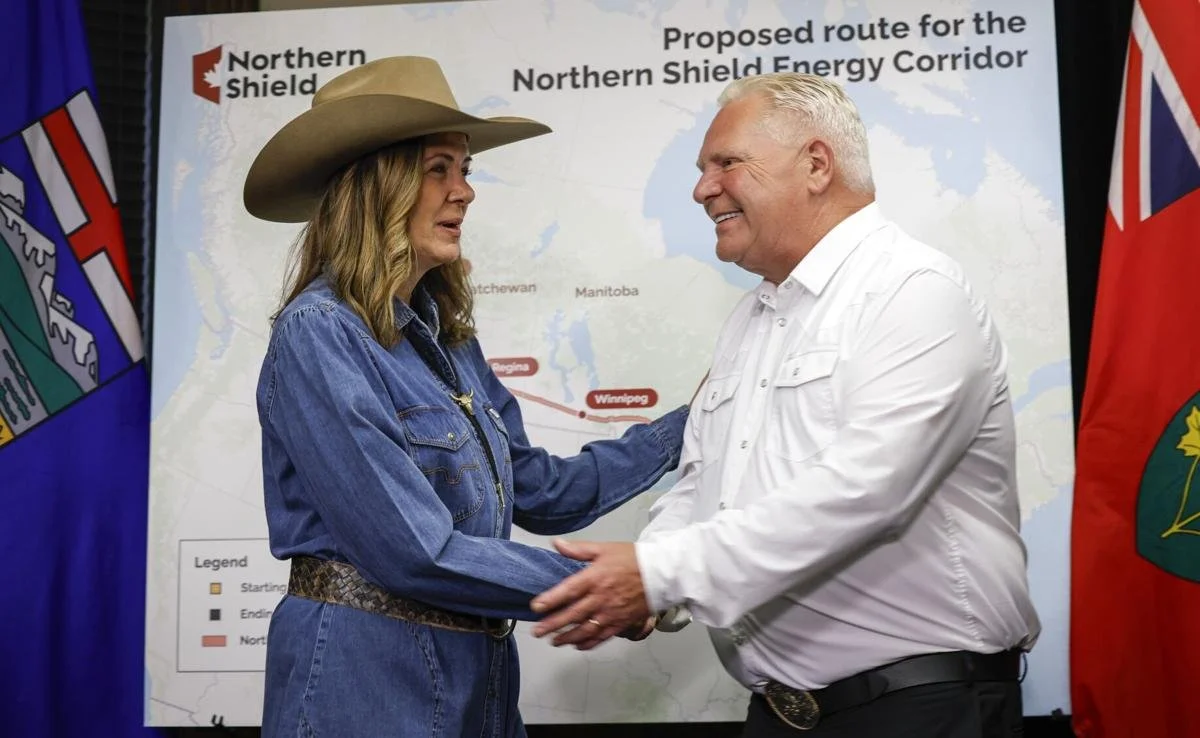
Ford and Smith’s Northern Shield Energy Corridor proposal would move Alberta crude eastward to refineries in Ontario. Supporters have also argued that it should ultimately extend to Saint John, New Brunswick, giving Canadian oil access to Atlantic markets.
The proposal faces significant practical challenges. It lacks a confirmed private-sector proponent, would require cooperation across several provinces, and could face regulatory, political, and Indigenous consultation hurdles.
Critics have dismissed it as more political branding than viable infrastructure. TVO’s John Michael McGrath argued that the pipeline lacks a clear business case and may never be built.
But the strategic logic behind east-west infrastructure is becoming harder to ignore.
A country that relies almost entirely on one customer will always be vulnerable to that customer’s political decisions. The answer is not to cut off existing sales before alternatives exist. The answer is to build alternatives.
A pipeline to the West Coast expands access to Asia. A pipeline east would strengthen domestic energy security and potentially open access to Europe. Additional LNG capacity would give Canadian natural gas producers more options beyond the continental market.
That is real leverage.
Threatening to shut off exports is temporary leverage that damages both sides. Building infrastructure creates permanent bargaining power because Canada is no longer forced to accept whatever terms its largest customer offers.
A National Unity Test
The debate also exposes a growing regional tension in Canada’s tariff response.
Ontario and Quebec face the greatest immediate pressure from tariffs on manufacturing, autos, dairy, and other products. Alberta and Saskatchewan remain more protected because energy and potash have largely been spared.
Ford wants western resources used to create pain in the United States. Smith and Saskatchewan Premier Scott Moe see that as asking the West to sacrifice its strongest industries to defend sectors elsewhere.
Economist Jack Mintz has argued that Alberta and Saskatchewan’s stronger economies will already help absorb some of the national impact. Higher federal revenues from the West can fund support for workers and industries in harder-hit provinces. Equalization and interprovincial labour mobility also provide mechanisms for sharing the burden.
That may not satisfy politicians looking for an immediate and visible response, but it is economically more coherent than weakening the sectors still generating growth.
Canada will need national unity to navigate a more volatile relationship with the United States. But unity cannot mean treating Alberta’s exports as expendable whenever Ottawa or Ontario wants additional negotiating leverage.
A durable national response must recognize that the strength of one province can help support the others.
It should not require weakening that strength first.
Diplomacy Without Illusions
There is no guarantee that diplomacy will succeed.
Trump has repeatedly demonstrated a willingness to use tariffs as an instrument of political pressure, even when doing so disrupts American businesses and consumers. Canada cannot assume that economic integration alone will prevent further escalation.
Ottawa and the provinces should prepare targeted responses, support affected industries, challenge unjustified measures, and build stronger trading relationships outside the United States.
But Canada should avoid turning its most valuable exports into symbolic weapons.
Heather Exner-Pirot of the Macdonald-Laurier Institute argued that energy and minerals have been among the most resilient parts of Canada’s economy during the trade dispute.
“The resilience of energy and minerals in the past year, and their exclusion from tariffs, has been a huge net positive for the Canadian economy,” she said. “It’s not helpful to inject uncertainty into these sectors by floating the idea of using them as retaliation.”
That is the wiser course.
Canadian oil, natural gas, potash, and electricity are sources of national strength. They support jobs, government revenues, exports, and economic stability at a time when other industries face serious pressure.
Canada should use that strength to negotiate, diversify, and build.
It should not switch it off.