

Alberta’s AI Power Play
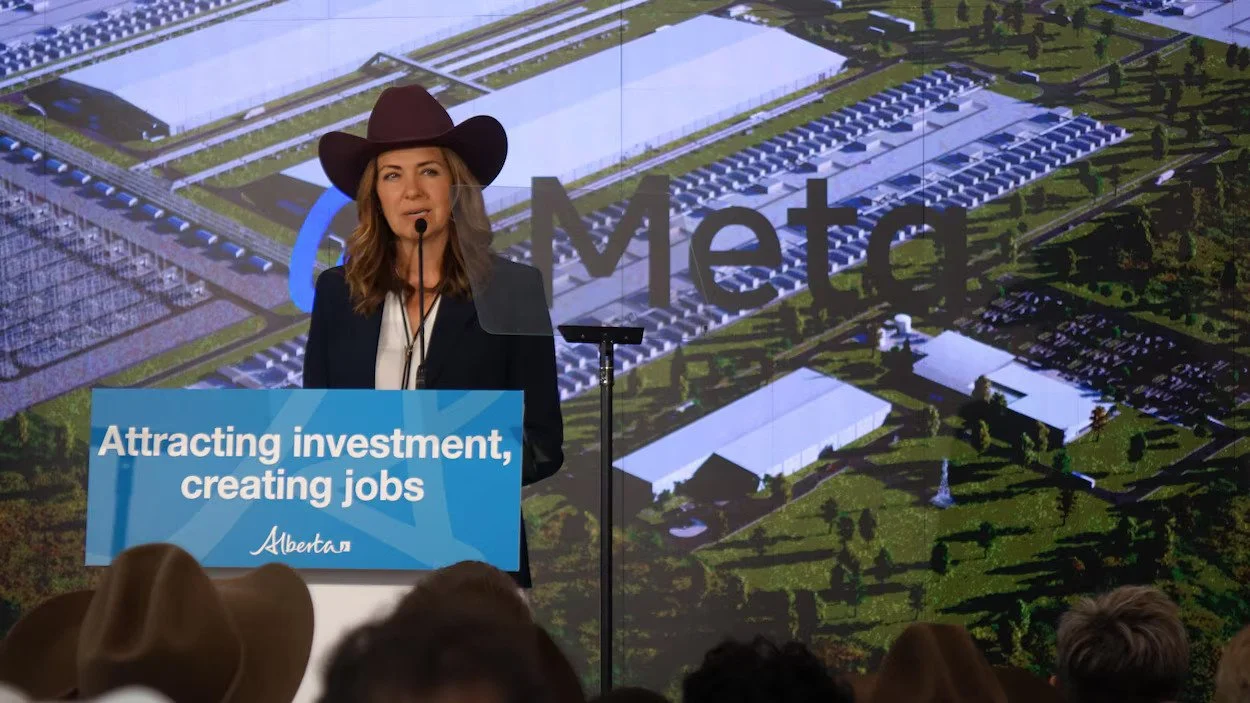
Source: Radio-Canada
Alberta’s AI Power Play
Meta’s announcement that it will invest more than $13 billion in a new hyperscale data centre northeast of Edmonton represents one of the largest private-sector investments in Canadian history, the largest data centre project ever proposed in the country, and an early test of Alberta’s strategy to turn its traditional energy advantages into a foothold in the rapidly expanding artificial intelligence economy.
Meta’s first Canadian data centre is expected to create more than 3,000 construction jobs and approximately 300 permanent operational positions. The province estimates it will generate roughly $250 million annually through taxes, royalties, levies, and fees. Meta will also invest approximately $60 million in local roads, water infrastructure, and other improvements.
Those figures alone would make the announcement notable. But the larger story is what the investment says about Alberta’s economic strategy.
For years, governments across Canada have spoken about diversifying away from traditional resource industries. Alberta is now attempting something different: using the province’s energy resources, industrial land, infrastructure, and regulatory culture to compete in a new industry whose demand for electricity is growing at an extraordinary pace.
Premier Danielle Smith put the government’s argument plainly.
“Artificial intelligence is transforming the global economy, and Alberta is making sure we lead rather than follow,” she said. “We created the right conditions to attract world-leading investments while protecting the interests of Albertans.”
That is the political case for the project. Alberta is not abandoning its resource economy to pursue technology. It is attempting to use one to power the other.
Smith later described the project in even more characteristically Albertan terms, calling it a “digital refinery.” In her telling, the province is taking natural gas and converting it into the computing power that drives artificial intelligence.
“This is upgrading our natural gas into zeros and ones,” she said.
It is an effective framing. Alberta governments have long been criticized for exporting raw resources without capturing enough value at home. Data centres offer the government an opportunity to argue that natural gas can be transformed into a higher-value product without being physically exported through a pipeline.
A Project Built Around Power
The Sturgeon County campus is planned as a gigawatt-scale operation, with approximately 2.9 million square feet of facility space. The project will initially rely partly on grid-connected electricity before being supported by the new Greenlight Electricity Centre, a $4.6-billion natural gas-fired generation facility being developed by Pembina Pipeline Corporation, Morgan Stanley Infrastructure Partners, and Kineticor.
The first phase of Greenlight is expected to produce more than 900 megawatts, with regulatory approval to expand beyond 1,800 megawatts. In practical terms, the initial facility will produce roughly enough electricity to power a major Canadian city.
This is where Alberta’s competitive advantage becomes clearest.
Artificial intelligence requires enormous amounts of continuous, reliable electricity. Alberta has abundant natural gas, available industrial land, a skilled construction workforce, cold weather, and a government willing to move quickly.
Meta executive Gary Demasi cited access to infrastructure, energy, labour, and community partnerships as reasons the company selected Sturgeon County.
“The right elements were there to make this location a globally attractive location for us,” he said.
Technology and Innovation Minister Nate Glubish was more direct: “Meta is voting with their wallet.”
That may be the most important message for other potential investors. Alberta’s data centre strategy was no longer theoretical the moment one of the world’s largest technology companies committed billions of dollars.
The province has set a target of attracting $100 billion in data centre investment by 2030. That remains ambitious, but the Meta project makes it more credible than it was a week ago.
Capital Power CEO Avik Dey called the announcement a “watershed moment,” arguing it validates Alberta as a market for hyperscale data centres. Glubish described it as “the first domino of many to fall.”
There is evidence the pipeline of interest is real. The Alberta Electric System Operator has reportedly received connection requests from 41 prospective data centre projects representing 19.5 gigawatts of potential electricity demand.
Not all of those projects will proceed. They could not all be accommodated under the current system. But the volume of interest shows that Alberta has successfully attracted the industry’s attention.
No Public Cheque
From a conservative perspective, one of the strongest aspects of the announcement is the absence of a large direct public subsidy.
The province says Alberta taxpayers will not fund the project’s construction. Meta is expected to pay for the necessary generation and grid infrastructure, along with local upgrades. The government has emphasized that there are no direct provincial grants, tax abatements, or public equity investments behind the announcement.
That distinguishes the deal from many major industrial announcements across Canada, where federal and provincial governments have committed billions of dollars to attract battery plants, electric vehicle manufacturing, and other large projects.
The government’s “bring your own power” approach is also designed to ensure that massive new electricity consumers contribute to new supply rather than simply drawing from a grid already serving households and businesses.
Meta has said it will pay the full cost of required upgrades and ensure other customers are not left carrying the burden. The province argues that the company’s transmission payments could reduce the transmission portion of Albertans’ utility bills by up to six per cent.
“It’s really critical that other consumers do not in any way take on any of the burden of the fact that we are there,” Demasi said.
The project will begin operating before Greenlight is completed, meaning Meta will initially depend more heavily on grid-connected electricity. The province maintains that the system can accommodate the project without compromising reliability, pointing to an independent AESO determination that 1,200 megawatts could be allocated to major data centres.
Two Very Different Stories
The difference in how the announcement was covered is revealing.
The Alberta government presented the project as an unqualified economic breakthrough: billions in private investment, thousands of jobs, new government revenue, lower transmission costs, and proof that the province can lead the artificial intelligence economy.
Much of the business coverage shared that sense of scale. Calgary Herald columnist Chris Varcoe placed the announcement in the context of global competition for AI infrastructure, describing it as Alberta’s first major hyperscaler and the province’s largest capital investment since the Fort Hills oilsands project. That coverage focused heavily on investment, power generation, supply chains, and the possibility that the project will attract additional companies.
CBC News and Canadian Press coverage took a different approach. Their stories were framed around public anxiety, including concerns about water use, grid demand, decommissioning, and the possibility that households could end up subsidizing the project. Smith’s weekend radio appearance was covered primarily as an exercise in reassuring worried Albertans.
David Climenhaga’s left-wing Alberta Politics blog was more openly hostile. It questioned whether the project’s 300 permanent jobs justified its scale and raised concerns about water consumption, gas demand, emissions, waste, and the ultimate flow of profits out of Alberta.
They reflect fundamentally different judgments about which facts matter most. Government and business coverage asked: How large is the investment, and can it attract more?Critical coverage asked: What are the risks, and who will carry them?
For government-relations professionals and industry leaders, both sets of questions matter. The economic opportunity is real, but so is the growing public resistance to large data centres across North America. Projects have faced opposition related to noise, farmland, water, electricity prices, and local consultation.
Alberta’s ability to attract further investment will depend partly on whether the Meta project proves the province can manage those concerns better than competing jurisdictions.
The Water Question
The government has clearly recognized that water use is one of the most politically sensitive aspects of data centre development.
Meta says the Sturgeon County site will use a closed-loop liquid-cooling system combined with dry cooling, requiring no operational water for cooling. Water use will be limited to domestic purposes, fire protection, maintenance, and related functions.
The company estimates the facility will use approximately 60 cubic metres per day, less than a typical Alberta golf course.
Beyond the Data Centre
The Meta announcement was followed one day later by a $50-million provincial investment in the Alberta Machine Intelligence Institute.
Alberta has been a leader in artificial intelligence research for more than two decades. Amii is one of Canada’s three national AI institutes and is internationally recognized for its work in reinforcement learning. Its chief scientific adviser, Richard Sutton, was a co-recipient of the 2024 Turing Award.
The province’s new funding is intended to accelerate the use of AI in health care, education, social services, and the private sector, while helping Alberta retain the intellectual property and companies that grow out of publicly supported research.
Together, the announcements suggest a more comprehensive strategy than simply hosting server farms. The government wants Alberta to produce the energy, host the computing infrastructure, conduct the research, commercialize the technology, and apply it throughout the economy and public sector.
A Calculated Bet
There are legitimate questions about the Meta development.
Greater natural gas demand could affect energy markets. The promised transmission savings will need to materialize. Water, noise, and local impacts will require transparent monitoring. Governments must also prepare for the possibility that rapidly evolving technology could someday make facilities obsolete.
But major economic opportunities rarely arrive without risk.
Alberta’s greater danger would be watching from the sidelines as trillions of dollars flow into artificial intelligence infrastructure elsewhere.