

Pierre Poilievre’s Federalist Offensive
CBC
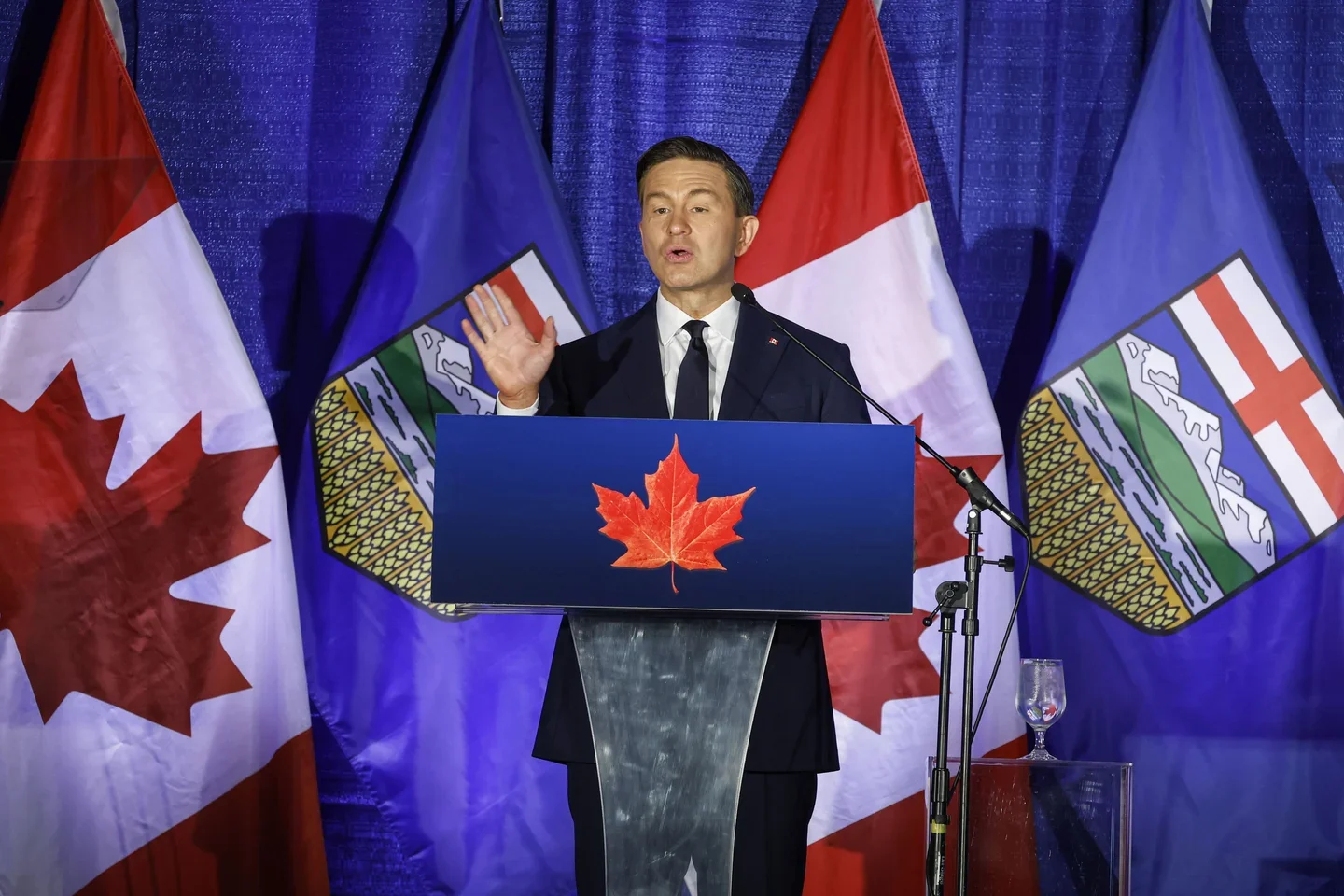
Pierre Poilievre came to Calgary last Monday with a message aimed at two audiences at once.
The first was obvious: Albertans angry enough with Ottawa to consider voting for a future referendum on separation. The second was much larger: Canadians watching to see whether the Conservative leader can present himself not merely as an opposition fighter, but as a national leader capable of holding the country together.
Recent federal polling has shown the Conservatives slipping below 30 per cent nationally, a dangerous place for a party that, not long ago, appeared on track to form government. For Poilievre, Alberta’s unity debate may offer something his party badly needs: an opportunity to change the channel.
After months of reacting to Prime Minister Mark Carney’s early agenda, Poilievre now has a chance to define himself around a larger theme. National Unity gives him a platform that is emotional, economic, constitutional, and deeply political. It allows him to speak to western alienation while also reassuring Canadians outside Alberta that he is committed to keeping the country together.
This is an easier line for Poilievre to walk than it is for Premier Danielle Smith.
Smith is trying to manage a UCP membership that is far more sympathetic to independence than the general electorate. She must argue for Canada while keeping onside a base that wants Alberta to be more confrontational, more autonomous, and, in some cases, fully independent. Her challenge is to oppose separatism without appearing to dismiss the grievances that feed it or initiating a leadership challenge. Remember Jason Kenney?
Poilievre’s challenge is different. As the leader of a national party, his audience is overwhelmingly federalist. He does not need to appease a pro-independence party base in the same way Smith does. He can spend the summer and fall delivering a unity message that plays in Calgary, Vancouver, St. John’s, Toronto, and Quebec City: Alberta’s problem is not Canada. Alberta’s problem is Ottawa.
That was the core of his Calgary speech.
“We do not need a different country, Alberta. We need different government policies in Ottawa,” Poilievre said.
The message from Poilievre validates Alberta’s frustration without validating separation. It blames federal policy rather than Confederation itself. It allows him to stand against independence while continuing to attack Liberal energy, firearms, criminal justice, taxation, and regulatory policies.
In other words, it lets him campaign for Canada while still campaigning against the Carney government.
Poilievre’s team clearly understood the importance of the moment. Before the speech was delivered, excerpts were provided to media, allowing pre-positioning stories to trickle out late Sunday and Monday morning. That advance work helped build anticipation and ensured the launch would be covered as a deliberate landmark event, rather than another speech from the Conservative leader to Albertans.
The speech itself was delivered in Calgary, at a moment when Alberta separatism continues to attract national attention. Poilievre used that attention to argue that who are considering separation should not be treated as enemies.
“As we debate the fight for a united Canada, we must remember that those who are choosing separation from Canada are not our enemies,” he said. “They are our fellow citizens, family members, loved ones, business partners, neighbours and friends.”
That tone is politically important. Separatism is still unpopular with the broader electorate, but a significant number of Albertans remain open to using the referendum as a way to send a message to Ottawa. Demonizing those voters risks pushing them further into the separatist camp. Poilievre instead chose persuasion.
“Demonizing people who have lost hope in Canada is no way to restore it,” he said. “Name-calling, fearmongering and ostracizing will only worsen and broaden the divide.”
That is also where Poilievre’s speech differs from much of the federal Liberal response. Carney has called Smith’s referendum a “dangerous bluff”. That may be an accurate description of the political risk, but it does not necessarily persuade disaffected Albertans. Poilievre is betting that a more empathetic approach will work better: hear the grievance, redirect the anger, and offer policy change as the alternative to separation.
The policy list was familiar. Poilievre called for unblocking resources and pipelines, respecting firearms owners, locking up criminals, relieving taxpayers, respecting provincial autonomy, and unlocking free enterprise. He urged Alberta to “lock arms” with other provinces, including Saskatchewan, Newfoundland and Labrador, Ontario, and Quebec, to demand change from Ottawa.
Instead of presenting these positions as a Conservative platform alone, Poilievre is now presenting them as a national unity agenda. Repealing federal “anti-development” laws, expanding pipeline access, restoring provincial authority over areas like immigration, and reducing Ottawa’s regulatory footprint are being cast as the practical path to keeping Alberta in Canada.
The Conservative team also made sure the message reached Ottawa audiences. Leduc-Wetaskiwin MP Mike Lake was deployed as the lead interview on both CBC’s Power and Politics and CTV’s Power Play, where he reinforced the core pitch: Conservatives “hear” Alberta, and a stronger Alberta means a stronger Canada.
On CBC, Lake argued that Albertans feel ignored or disrespected by people outside the province who have “very strong opinions” on what Albertans should think. His answer was not separation, but better national conversations. “Everybody wants to be respected for that contribution,” Lake said, arguing that Albertans feel that respect has too often been missing.
On CTV, Lake returned to the same practical test Poilievre set in Calgary: words are not enough. “My constituents in Leduc-Wetaskiwin want to see some action,” he said. He argued that if Ottawa repealed Bills C-69 and C-48 and moved seriously toward getting pipeline construction underway, it would “go a long way immediately to releasing some of the tension.”
But the interviews also revealed where Conservatives will face pushback.
Lake repeatedly pointed to the Harper government’s record, arguing that in 2015 there were three pipelines “in the pipeline” — Energy East, Northern Gateway, and Trans Mountain. Both David Cochrane and Vassy Kapelos challenged that framing, pointing out that Northern Gateway faced court issues, Energy East faced changing conditions and opposition, and western alienation did not begin with Justin Trudeau.
That exchange matters because it shows the limits of the Conservative argument. Blaming the Trudeau decade is politically effective, especially in Alberta. But if Poilievre wants this to become a national unity message rather than a regional grievance message, he will need to acknowledge that Alberta’s frustrations have deeper roots than one prime minister.
Still, the Conservative critique of the Carney government is clear. Smith has argued that Alberta is finally winning concessions from Ottawa, pointing to the energy memorandum of understanding and the prospect of a new West Coast pipeline. Poilievre has praised Alberta’s fight but remains skeptical of Liberal promises.
“It will take shovels moving dirt and steel pipe in the ground to show the Liberals have really changed their minds on oil and gas,” he said. “Albertans can be forgiven for demanding results, not just more promises.”
In a post-speech interview with Rick Bell, Poilievre was sharper still. He argued Carney should come to Alberta and “denounce everything he and his party have done for the last decade,” including policies on oil and gas, firearms, law and order, and carbon taxes. Poilievre suggested it would help heal national wounds if Carney admitted he was wrong.
It is vintage Poilievre: combative, direct, and relentless in linking Carney to the Liberal record. But will it work?
With the campaign barely underway, it is too early to say. The launch received coverage. It generated attention in Alberta. It gave Conservative MPs a message to carry into national media. But it did not dominate the week. Despite advance excerpts, the Calgary speech, and Lake’s media circuit, the story did not lead news cycles for long.
National unity campaigns are not won in a single speech. They require repetition, regional presence, disciplined messaging, and credible surrogates. If Poilievre and his caucus spend the summer consistently making the case that Alberta’s place is inside Canada, while arguing Ottawa must change to make Confederation work better, they may shape the referendum debate on terms favourable to Conservatives.
The opportunity is real. Polling continues to show that most Albertans want to remain in Canada. Recent Calgary numbers are especially blunt: three-quarters of Calgarians reportedly favour remaining in Canada, while only about one in five support moving toward a yes-or-no independence vote. That gives federalists room to be confident, but not complacent.
The danger for Poilievre is that his message may sound too much like the separatist diagnosis with only a different conclusion. Critics have already argued that by blaming Ottawa so heavily, he risks reinforcing the anger he claims to be trying to redirect.
If he can become the face of a confident, reform-minded federalism, the unity campaign could help broaden his appeal at a moment when his party needs it most. If the message fails to travel beyond Alberta, it risks becoming just another regional grievance exercise.
Poilievre is not trying to outflank Smith on separatism. He is trying to offer Conservative voters a federalist off-ramp — one that lets them reject separation without surrendering their anger at Ottawa. In a country where national unity has once again become a live political issue, that may be exactly the role he wants to play.