

Top Five Stories from the 2026 Spring Legislative Session
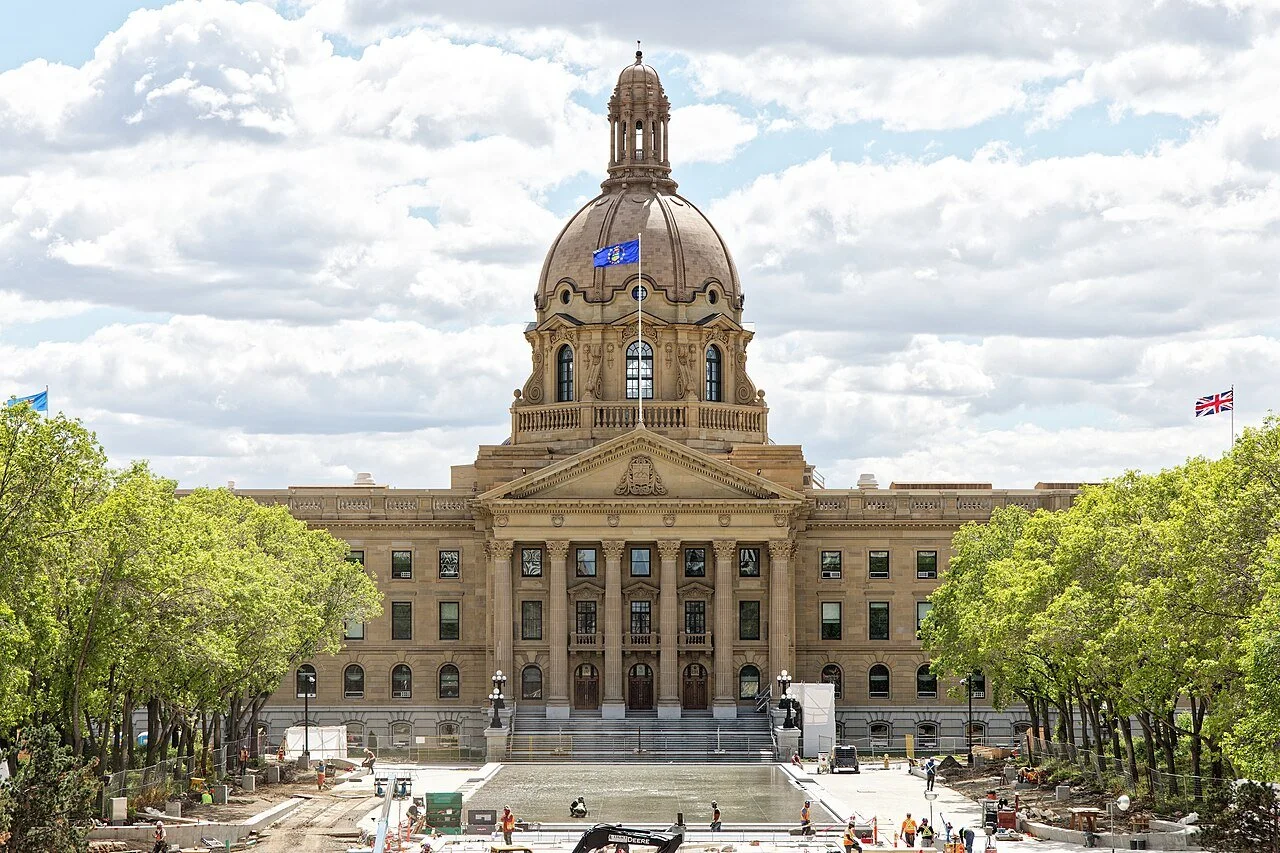
Jeff McIntosh/The Canadian Press.
1. Separatism
Of course, separatism had to take the top spot. No issue attracted more political attention this session, not only in Alberta, but across the country.
For Premier Danielle Smith, the issue has required the most delicate balancing act of her premiership. On one side sits a vocal segment of her base demanding greater autonomy, and in many cases outright independence. On the other sits a broader electorate firmly committed to remaining in Canada, even while expressing frustration with Ottawa.
The result has been a political tightrope unlike any seen in modern Alberta (Canadian?) politics.
Ironically, Smith has become the first federalist premier in Canadian history to initiate a province-wide vote on separation – or more accurately, a referendum on whether Alberta should begin the process of pursuing a referendum on separation. While critics have accused her of legitimizing the movement, Smith has argued that suppressing the debate would only intensify it. “Alberta’s future will be decided by Albertans, not the courts,” she declared in her address to the province.
At the same time, she has become increasingly forceful in outlining the realities of independence. This week saw Smith make her most aggressive case yet against separation, pointing to estimates that an independent Alberta could face nearly $400 billion in start-up costs, along with the challenge of assuming portions of the national debt, establishing military and border infrastructure, and recreating federal programs from scratch. “People need to understand what it would be to set up a fully functional national government from scratch,” Smith said.
Smith has begun invoking Brexit as a cautionary tale, arguing that political divorces are rarely as simple as their advocates suggest. Interestingly, while many separatists point to Brexit as proof their movement can succeed, they are less inclined to reference the far more comparable Scottish independence referendum, where voters ultimately chose to remain within the United Kingdom.
With a referendum now scheduled for October, the debate has moved well beyond the political fringe. Whether separatism is a political force to be reckoned with, and whether Smith can hold together a divided coalition, remains to be seen.
2. Pipeline MOU
While separatism continues dominating headlines, the Alberta-Ottawa Memorandum of Understanding (MOU) may ultimately prove to be the most consequential policy development of the session.
For years, Alberta conservatives argued that federal policy under former Prime Minister Justin Trudeau had made major infrastructure projects impossible to build. Under Prime Minister Mark Carney, Ottawa is taking a markedly different approach. The MOU signed with Alberta commits Ottawa to supporting a new Indigenous co-owned West Coast pipeline, abandoning the federal emissions cap, shelving the Clean Electricity Regulation in Alberta, and reducing the trajectory of the federal carbon tax.
In many respects, it represents the Carney government’s clearest departure from the Trudeau-era climate agenda.
Smith called the agreement proof that “Canada and Alberta are serious about expanding market access, building major infrastructure and creating the conditions for long-term investment in our province’s energy sector.” Carney framed the deal as evidence that “one project means one review” and that governments can work together to advance major projects.
The politics behind the MOU are impossible to ignore. With separatist sentiment rising, Ottawa has every incentive to demonstrate that Alberta’s concerns are being heard. Smith herself has suggested the MOU will help win back Albertans who have become disillusioned with Confederation.
Not everyone is convinced. British Columbia NDP Premier David Eby accused Ottawa of “rewarding bad behaviour” and questioned why a pipeline without a route or proponent was receiving federal attention. His criticism may resonate in Victoria, but it creates an awkward dynamic for Alberta’s NDP. While Naheed Nenshi has criticized aspects of the UCP’s approach, attacks from Eby risk reinforcing the UCP’s longstanding argument that the NDP is one environmental monolith opposed to Alberta’s economic interests.
Whether the MOU ultimately results in a pipeline remains an open question. But politically, this plan for a plan marks a real shift in federal-provincial relations. Alberta and Ottawa are finally talking about how to build energy infrastructure together, rather than fighting over whether it should be built at all.
3. Immigration and Constitutional Reform (the other referendum)
While the separatist question has understandably attracted the most national attention, the UCP’s broader October referendum may still prove politically useful.
The ballot will include nine questions focused on immigration and constitutional reform, including whether Alberta should take greater control over immigration, restrict access to some provincially funded services for non-permanent residents, require proof of citizenship to vote, and pursue constitutional changes around judicial appointments, Senate abolition, opt-outs from federal programs, and provincial authority in areas of shared jurisdiction.
Politically, the immigration questions are where the UCP is on the strongest ground. Public frustration is no longer confined to the UCP base. It has moved into the broader electorate, particularly as voters connect population growth to pressure on housing, schools, emergency rooms, and social services. One CBC-commissioned poll found 57 per cent of Albertans support the province taking more control over immigration.
Smith has framed the referendum as giving Albertans “a direct say on immigration and constitutional questions that affect our economy, our public services and our province’s future.” Justice Minister Mickey Amery similarly argued the vote is about “prioritizing the needs of citizens and making Alberta stronger.”
The political logic is clear. If voters reject a future separatist referendum but support the immigration and constitutional reform questions, the UCP may gain something close to an ideal outcome: a way for its base to vent frustration with Ottawa while giving the broader electorate a less destabilizing alternative to independence.
4. Electoral Boundaries
For decades, Alberta has relied on an independent Electoral Boundaries Commission to redraw riding boundaries after public consultation. This year, however, the government declined to simply accept the commission’s majority report and instead created a special legislative committee to oversee a new review process. That decision is unprecedented and has immediately triggered accusations that the UCP is attempting to politically shape future electoral maps.
Opposition members have repeatedly described the process as illegitimate. During the committee’s first meeting, NDP MLA Kathleen Ganley argued that the government had overridden “the normal process” and inserted politicians into a task that should remain independent, saying that “politicians should not be picking their voters.”
The controversy deepened when Alberta’s Acting Chief Justice declined a committee request to help recruit judges for the new advisory panel, describing the process as an “irregularity” and noting that the usual conventions surrounding electoral boundaries commissions had not been followed.
Compounding concerns is evidence that the competing minority report would have produced substantially different political outcomes. A CBC analysis found that, had the 2023 election been conducted under the minority report’s proposed boundaries, the UCP could have won as many as 56 seats rather than 49, while several closely contested urban and suburban ridings would have shifted in the party’s favour.
The government rejects allegations of political interference, arguing that its goal is to ensure “effective representation” while expanding the Legislature from 89 to 91 seats. UCP MLA and Committee Chair Brandon Lunty said the new process is intended to “ensure effective representation as guaranteed by the Canadian Charter of Rights and Freedoms.”
Still, the politics of the issue are unlikely to fade. If the eventual map closely resembles the minority report or otherwise produces boundaries that appear unusually favourable to the governing party, accusations of gerrymandering will intensify. The debate has already been coloured by procedural controversies.
5. Dual Practice Health Care
If there’s one issue that has defined provincial politics across Canada, it is health care. That is why Alberta’s move toward a dual-practice health care model may ultimately prove to be one of the most politically consequential decisions by Premier Smith.
The policy would allow physicians to participate in both the public and private systems, providing publicly insured services while also offering private-pay care under a regulated framework. The government argues the model will increase capacity, reduce wait times, and help attract and retain health professionals in a highly competitive labour market. Premier Danielle Smith has described dual practice as a “practical, proven tool” that will allow surgeons to do more procedures while shortening wait lists.
For years, health care privatization has been treated as a third rail in Canadian politics. Governments have often flirted with private delivery or market-based reforms but have generally avoided openly embracing them. Smith has taken a different approach. Rather than sidestepping the debate, she is deliberately challenging long-standing assumptions about how health care should be delivered.
It is a significant political gamble. The government is betting that Albertans care more about getting timely access to care than they do about preserving traditional distinctions between public and private delivery. If wait times fall and more physicians choose Alberta because of the added flexibility, the government will point to the model as evidence that reform works. If public system pressures worsen, critics will argue the province has accelerated a drift toward a two-tier system.
That debate is already underway. Health advocacy groups have argued the legislation risks undermining the principles of the Canada Health Act, while physician groups have called for extensive safeguards to ensure the private system does not draw doctors and staff away from public care.
As implementation of the dual-practice model moves forward, Albertans can expect a growing debate over whether the government is modernizing the system or privatizing it. Regardless of where voters land on that question, it is almost certain to become a major point of discussion heading into the 2027 election campaign. Volunteers should expect to hear strong opinions from voters at the doors.