

A Pipeline at Last? Or a Plan for a Plan?
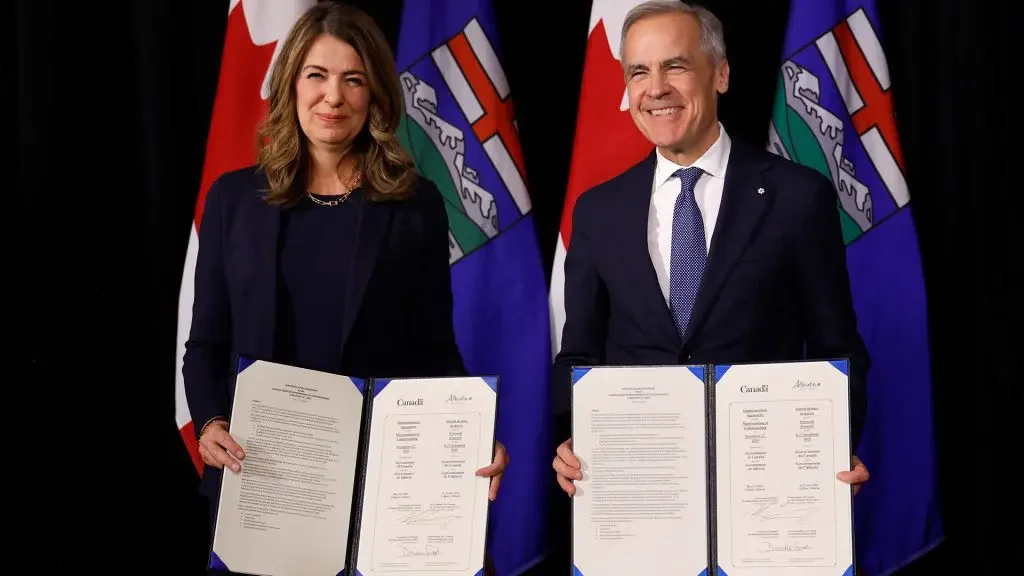
Jeff McIntosh/The Canadian Press.
For the first time in years, Alberta appears closer to achieving what conservatives have been demanding since taking office: a real pathway toward a new West Coast oil pipeline.
Whether that pathway ultimately results in shovels in the ground remains uncertain. But politically, the agreement signed last week between Premier Danielle Smith and Prime Minister Mark Carney marks a significant shift in tone, direction, and federal-provincial relations.
Ottawa has committed to treating the pipeline as a potential project of national interest by October 1, 2026 (the month as the potential referendum) while Alberta is expected to submit its proposal to the federal Major Projects Office by July 1. If approvals proceed according to schedule, construction authorization could arrive by September 1, 2027, a month before the next provincial election.
For the UCP, the dates matter almost as much as the project itself. Smith has spent years arguing that Ottawa’s regulatory environment has made energy infrastructure effectively impossible to build. The inclusion of written timelines and a streamlined “one project, one review” framework allows her government to argue something tangible has finally changed.
“That’s why we have got dates written in ink and signed by both myself and the prime minister,” Smith told columnist Rick Bell following the agreement.
The deal also represents an opportunity to lower the temperature of Alberta’s separatist movement. Smith herself acknowledged that reality directly, arguing the agreement would help “a group of folks who are disaffected because of economic issues.”
The calculation is understandable. Much of the separatist frustration in Alberta has been rooted in the belief that the province’s energy sector has been systematically constrained by Ottawa. A federally supported pipeline to tidewater directly addresses one of the movement’s core grievances. But whether it will actually calm separatist sentiment is another matter entirely.
Almost immediately after The Globe and Mail published Smith’s comments suggesting the deal would ease concerns among disaffected Albertans, separatist activist David Parker dismissed the idea outright.
“No, it won’t,” Parker wrote bluntly on X.
For many separatists, this agreement is not viewed as a breakthrough, but as another promise contingent on future approvals, future consultations, future investors, and future governments. In other words, it’s a plan for a plan for a plan.
Despite the celebratory tone surrounding the announcement, there is still no private-sector proponent attached to the project. No final route has been selected. No investors have formally committed capital. The British Columbia NDP government remains resistant. Several First Nations have signalled opposition. And the entire project remains heavily dependent on the successful completion of the long-delayed Pathways carbon capture initiative.
Even the federal concessions, though significant, reveal the political balancing act at the centre of the agreement.
Under the new framework, the industrial carbon tax will be substantially reduced from the previous Trudeau-era trajectory. Instead of reaching $170 per tonne by 2030, the carbon price will now rise more gradually, reaching $130 per tonne by 2035.
For industry, that reduction represents a meaningful concession and greater certainty. Alberta estimates the agreement could save industry partners approximately $250 billion through 2050. Collectively, they represent one of the most substantial retreats from the Trudeau-era climate framework seen to date. But not everyone is satisfied.
Conservative leader Pierre Poilievre continues to argue the industrial carbon tax should be zero. And among Alberta separatists, even a reduced price on carbon remains unacceptable. To many of them, the issue isn’t only the rate of the tax, but the principle itself: continued federal influence over Alberta’s energy sector.
The agreement is designed to demonstrate that cooperation with Ottawa can produce tangible gains for Alberta. But every compromise required to achieve that cooperation risks alienating the very voters she is attempting to win back from separatist movements.
The NDP, meanwhile, has attempted to frame the agreement very differently.
Naheed Nenshi acknowledged that the deal creates “some forward movement” and called it “good news, and necessary.” But he also argued that Alberta is now “exactly where it was when the UCP took power, at the starting line to get things built.” In his view, seven years were wasted fighting with Ottawa instead of building the partnerships required to move projects forward.
“Business needs stability and certainty,” Nenshi said. “Who is going to invest billions of dollars in a pipeline if they don’t even know what country that pipeline will be in?”
Nenshi’s broader criticism is that major projects require stability, certainty, and long-term relationships with industry, Indigenous communities, and local stakeholders, conditions he argues the UCP has weakened.
Even as Smith and Carney attempt to project certainty, the project remains surrounded by political volatility. The legal uncertainty surrounding Alberta’s separatist movement, tensions with First Nations, unresolved questions around routing through British Columbia, and the absence of a committed private-sector builder all continue to cloud the path ahead.
And yet, despite all those caveats, the agreement still represents something politically significant.
For the first time in years, Ottawa is not simply tolerating Alberta’s energy ambitions, it is actively participating in them. The federal government is now publicly attached to the success of a West Coast pipeline in a way that would have been difficult to imagine under Justin Trudeau.
Whether that ultimately leads to construction is still unknown.